You’ve just invested thousands of dollars in a new Learning Management System (LMS). Your team in Maputo completed the modules, certificates were issued, and the compliance box was neatly ticked.
Yet, the operational reality hasn’t changed.
The client with a 200-vehicle fleet is still waiting for technical support. Your corporate sales team still gives up after the very first “No.”
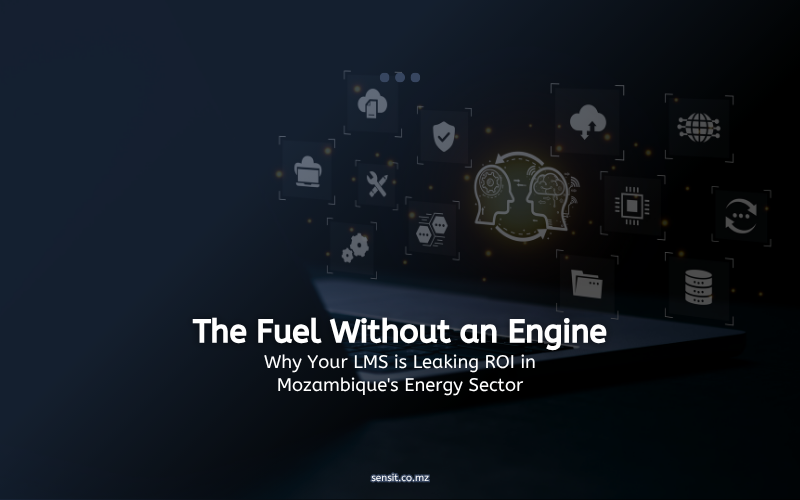
You gave them the fuel (the training modules), but you forgot to give them the engine (the execution architecture). In Mozambique’s Energy and Oil & Gas sectors, this massive friction point between learning and doing burns operational bandwidth and millions in lost productivity, like pouring petrol straight onto a fire.
The Diagnostic: Where the Value Leaks
According to a recent internal diagnostic conducted with a senior B2B Manager in Maputo’s fuel distribution sector, the bottleneck isn’t the content, it’s the follow-through.
He highlighted three critical systemic breakdowns:
- The KPI Trap: Employees are caught between delivering training hours and hitting commercial volume. Under pressure, they simply click through digital courses to clear a dashboard, absorbing absolutely nothing.
- The Post-Training Void: Learning stops the moment the module closes. There is no structured field shadowing or active coaching to lock the skills in.
“Devia haver muito shadowing depois das formações… para saber onde colocar mais esforços.”
- Habit Inertia: Without formal shadowing processes, old habits immediately override new knowledge. Employees end up only prioritizing non-negotiable safety or anti-money laundering (AML) modules.
- Operational, behavioral, or sales training is quickly written off as a “perda de tempo.”
The Mozambican Context: Speed is the Only Differentiator
In a mature energy sector where products are highly regulated and margins are fixed by the state, your only true competitive advantage is execution velocity.
As the B2B manager sharply noted:
“A proactividade… depende do quão flexível ou proactivos somos para pegar uma certa região onde o concorrente não foi.”
But how can a local team remain agile and proactive when their daily mental bandwidth is completely drained by:
- Regulatory Fear: Spending hours frozen by complex environmental and safety compliance codes instead of actively managing accounts.
- Decision Latency: Waiting days or weeks for an international board in another country to approve a flexible, localized solution for a client.
- Manual Overload: Servicing 200+ distant commercial clients via manual, reactive firefighting because there is no structured, proactive B2B assistance system.
The SENSIT Fix
We don’t view this as an employee performance failure. We view it as a system design failure.
An LMS is a library, it stores information. But an energy business is like a combustion engine. You don’t need more fuel, you need higher compression.
At SENSIT, we build the execution architectures that turn knowledge into market share:
- We build the missing infrastructure: Designing and embedding the exact post-training shadowing structures your line managers need.
- We institutionalize your “Hidden Genius”: Extracting the exact tactics of your single top performer, (the one who consistently turns a “No” into a “Yes”) and codifying it into a localized playbook everyone can execute.
- We contextualize the battlefield: Replacing generic, off-the-shelf international case studies with high-fidelity, Mozambican-specific scenarios inside a practical simulator.
Stop paying for fuel that leaks out before it ever reaches the wheels. Give your team the engine.
👉 Ready to bridge the execution gap?
Request a 60-minute Pre-Diagnosis Sync to map your team’s post-training shadowing gaps and build a localized execution blueprint.